Syrah in Tuscany: Cortona vs. the Tyrrhenian Coast
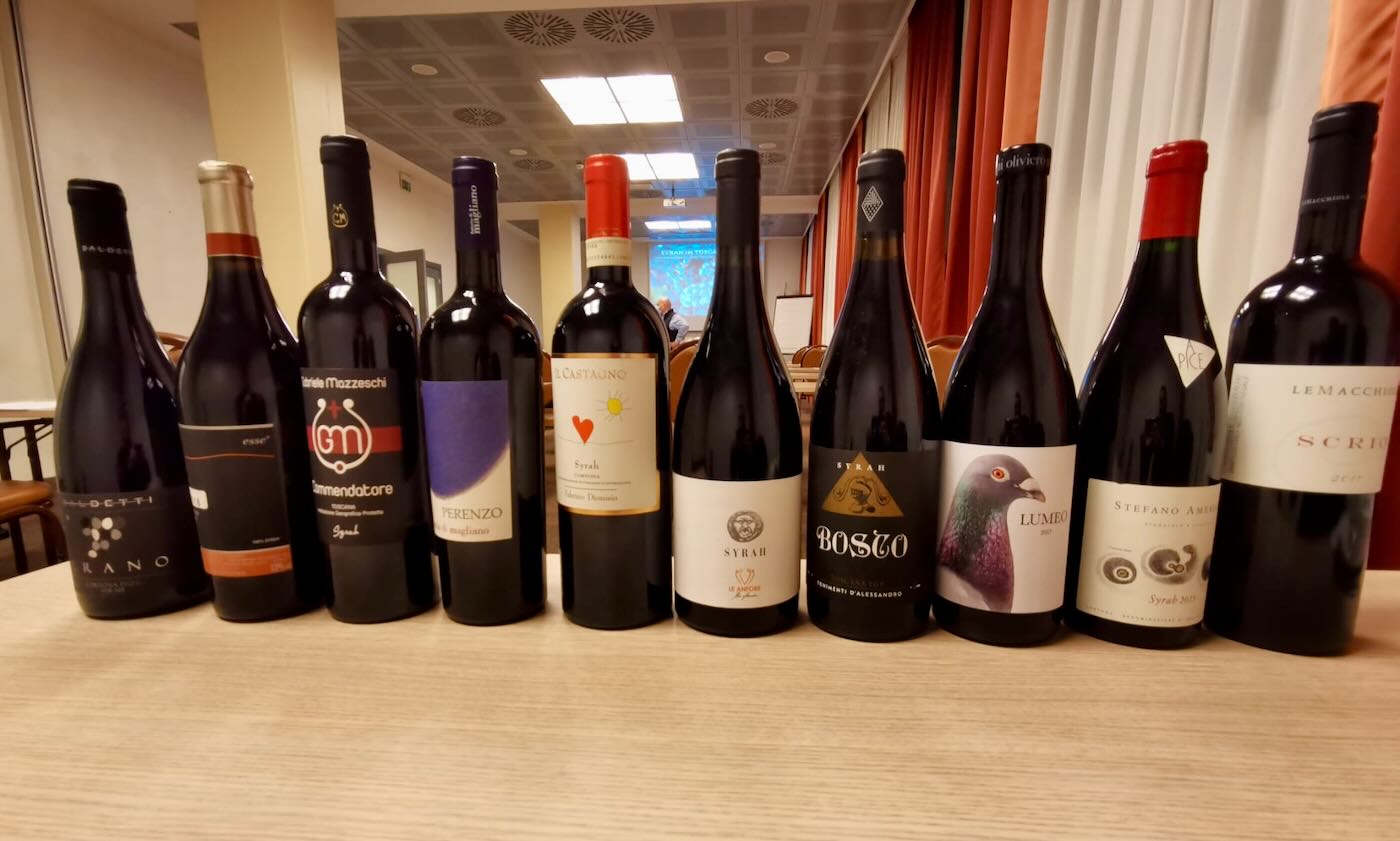
Ask most wine lovers to name Tuscany’s calling-card grape and they’ll say Sangiovese without blinking. But tucked into two very different corners of the region — the hilltop town of Cortona and the sun-baked Tyrrhenian coast — Syrah in Tuscany has quietly built a second identity for itself. Same grape, same region, remarkably different wines. So which one actually tastes more “Tuscan”? I put eleven bottles side by side to find out.
Not Sicilian, Not Persian — Just French
Let’s clear up a common mix-up first: Syrah has nothing to do with Siracusa, and despite the similar-sounding Iranian city of Shiraz, it isn’t Persian either. Genetic studies settled the matter decades ago — Syrah is a natural cross of two old Rhône Valley grapes, Mondeuse Blanche and Dureza, both now nearly extinct. It’s also a genetic cousin of Pinot Noir and Viognier. The grape likely grew around Côte-Rôtie as far back as Roman times, making it one of the oldest varieties still in commercial production.
And yes — “Shiraz” and “Syrah” are the exact same grape. Australia just prefers the other spelling.
Why Syrah Tastes the Way It Does
Syrah’s calling card is sheer polyphenolic muscle: thick color, firm tannin, and a deep purple hue that can take a decade or more to fade toward garnet — far slower than Sangiovese. But the real signature is aromatic, not structural: black pepper. That’s not a barrel note — it comes from rotundone, a naturally occurring aroma compound the grape produces in unusually high concentrations (research on rotundone’s role in wine aroma has been published in journals like the Journal of Agricultural and Food Chemistry). Humans can detect it at astonishingly low levels, which is why even a barrel-free, unoaked Syrah can smell distinctly peppery.
Two broad styles have emerged globally, largely shaped by the Rhône Valley’s own split personality:
- Northern Rhône style: low yields, taut tannins, mineral, savory, built to age — think Côte-Rôtie and Hermitage.
- International/”Australian” style: riper, rounder, fruit-forward, more immediately generous.
The difference usually comes down to yield and winemaking choices more than climate alone.
Where Syrah Grows in Tuscany
After Sicily, Tuscany is Italy’s second-biggest Syrah producer — though only in a couple of pockets. Cortona, near Lake Trasimeno, built an entire DOC around the grape starting in the 1990s, largely thanks to pioneering estates like Tenimenti d’Alessandro. Today Syrah feels almost native there. The other hotspot is the Tyrrhenian coast — the Bolgheri area between Pisa and Livorno, plus the Maremma further south. (For a broader look at how Tuscany’s official wine zones are structured, see our guide to Tuscany’s DOC and DOCG denominations.)
On paper, the two zones look like they should taste worlds apart: Cortona is Tuscany’s most inland, least maritime pocket, while the coast is classic Mediterranean. But dig into the numbers and the gap narrows:
| Cortona | Tyrrhenian Coast | |
|---|---|---|
| Soil | Clay over sandstone (same bedrock as Chianti Classico) | Looser, alluvial soils |
| Summer temps | Nearly identical | Nearly identical |
| Winter lows | Colder, near freezing | Milder |
| Elevation | 260–600 m | Mostly under 100 m |
Elevation turns out to be the one truly stark difference — everything else is closer than you’d expect.
The Tasting: Coast vs. Cortona, Blind and Alternating
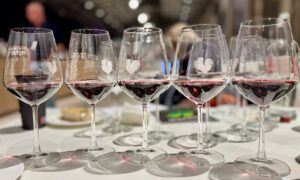
I lined up eleven Tuscan Syrahs, alternating coastal and Cortona bottlings, to see whether a real stylistic signature would emerge. A few standouts:
From Cortona, Stefano Amerighi’s Apice was the most cerebral wine of the flight — red fruit, rose petal, herbs, and a smoky edge, with racy acidity carrying long, precise tannins. Tenimenti d’Alessandro’s Il Bosco, the wine that put Cortona on the map back in 1992, showed remarkably little evolution after five years, all polished tannin and citrus-tinged length. Both leaned unmistakably toward the austere, savory Côte-Rôtie template.
From the coast, Le Macchiole’s Scrio, grown in the heart of Bolgheri, went the opposite direction: dark fruit, graphite, cardamom, and a muscular, generous palate — Mediterranean through and through. Elena Casadei’s amphora-aged Anfore, from Suvereto, was pure fruit and warmth, silky and immediately drinkable.
Across the board, the coastal wines leaned soft, fruit-driven, and Bordeaux-adjacent in body; the Cortona wines chased tension and restraint, closer in spirit to the northern Rhône. Worth noting: the bottles spanned several vintages, so some of what read as “style” may simply be age.
So Which Wins?
Wrong question. The real finding is that Tuscany’s Syrah doesn’t have one voice — it has (at least) two, and elevation seems to be doing more of the work than anyone gives it credit for. If you want power and immediate pleasure, look to the coast. If you want something more linear and built to last, Cortona is your zone.
FAQ
Is Syrah an Italian grape? No — it originated in France’s northern Rhône Valley. In Italy it’s most widely planted in Sicily, with Tuscany a distant but notable second.
Why does Syrah smell like pepper? Because of rotundone, a naturally occurring aroma compound in the grape itself — it has nothing to do with oak aging.
What’s the difference between Syrah and Shiraz? None, botanically. Same grape — “Shiraz” is just the name used mainly in Australia.
Where is Syrah grown in Tuscany? Mainly in two spots: the Cortona DOC near Lake Trasimeno, and the Tyrrhenian coast between Bolgheri and the Maremma.