Thirty Years in a Glass: Tasting Il Picchio at Castello di Querceto
If you’re planning a trip through the Chianti Classico hills and want to understand what makes this region’s wines so distinctive, there’s no better way than sitting down with a glass that has had thirty years to tell its story. That’s exactly what happened on October 20th, 2024 when I was invited to a vertical tasting of Il Picchio, the Chianti Classico Gran Selezione produced by Castello di Querceto, one of Tuscany’s most historic wine estates.
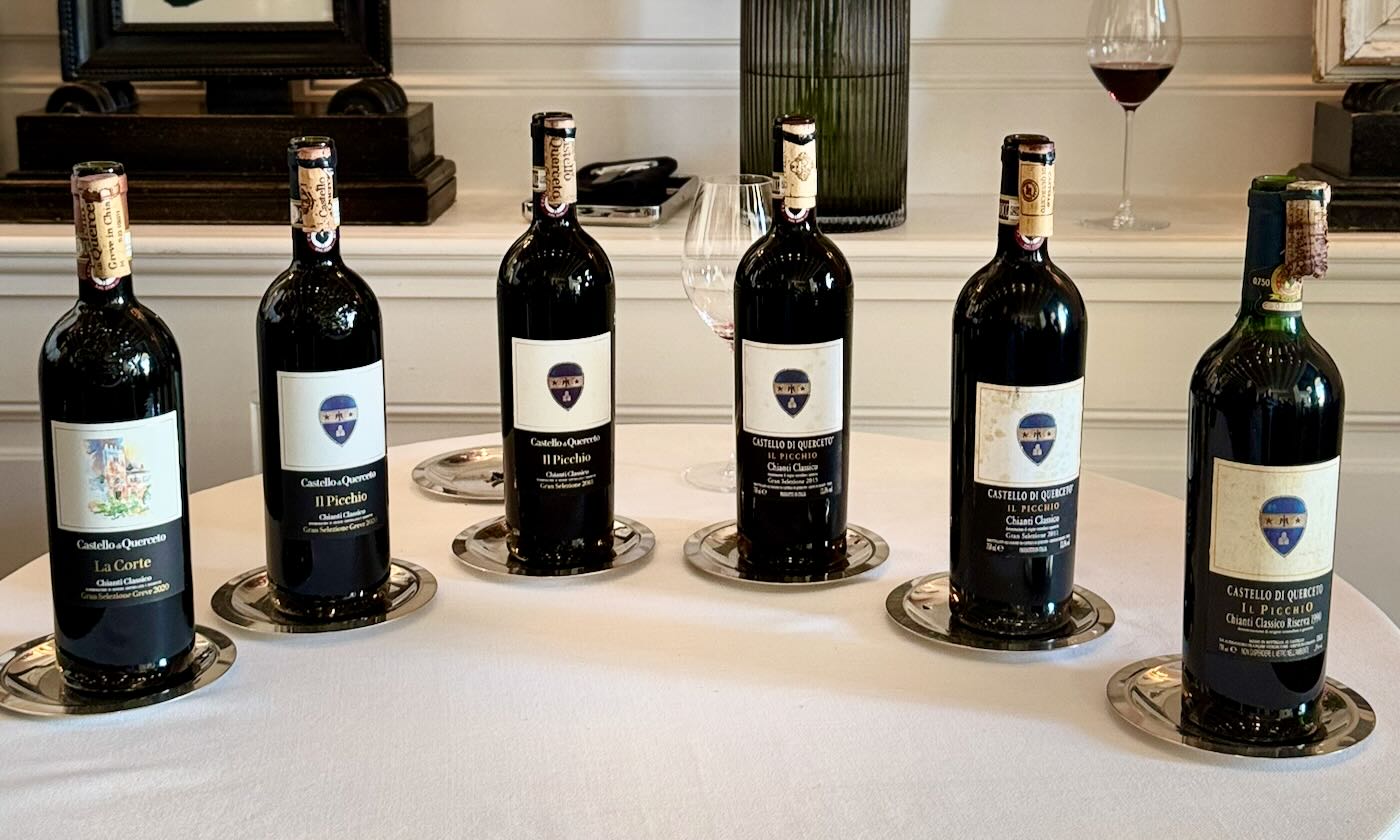
Six vintages, from 2020 back to 1990, poured side by side. It’s the kind of tasting that turns a wine into a timeline — and for anyone planning a wine tour in Chianti, it’s also a masterclass in what patience and terroir can do to Sangiovese.
A castle, a family, and a founding role in Chianti Classico
Long before “Chianti Classico” became a protected name recognized worldwide, a handful of families laid its foundations. Castello di Querceto was one of them: the current owner’s grandfather and great-grandfather were both among the 32 founding signatories of the Chianti Classico Consortium, the body that still safeguards the appellation’s standards today.
The estate itself grew out of a medieval ruin, rebuilt over the centuries into the castle that welcomes visitors now. Its winemaking story began in 1899, when the first Sangiovese vineyard was planted; by 1904 it had produced the estate’s first single-varietal wine, from a vineyard still known today as La Corte. Originally made for the family’s own table, that wine won an award at a competition in South America in 1910 — a success that convinced the family to expand well beyond the original five hectares. Today, the estate farms 75 hectares of vineyards and produces between 350,000 and 400,000 bottles a year, split across four IGT and four Chianti Classico DOCG labels.
For travelers with an interest in wine history, that continuity — the same family, the same hills, since the 19th century — is part of what makes a visit here worthwhile.
The terroir: high altitude, cool air, and multicolored schist
Castello di Querceto sits in Dudda in the municipality of Greve in Chianti, at the foot of Monte San Michele, the highest peak in the entire Chianti Classico appellation, on its eastern slope. It’s a cool, sheltered spot where Sangiovese ripens slowly, without the shortcuts that heat can force onto a vineyard. Getting there from Greve means driving through a stretch of forest — a reminder, before you even reach the cellar, that this is a more remote and rugged corner of Chianti than the postcard version most visitors expect.
The soil adds another layer of complexity: it’s made of polychrome schist, a mineral-rich rock that shifts in color from red to yellow to brown across the property. That geological variety shows up, glass after glass, in the wines’ aromatic depth and their notable ability to age — as this tasting proved.
Two wines, two personalities: La Corte and Il Picchio
Before diving into the vertical, the estate poured Il Picchio alongside its sister Gran Selezione, La Corte — a 100% Sangiovese grown on sandier soils. Tasting them side by side is the fastest way to understand the range Castello di Querceto works with.
La Corte is all finesse: a pale, luminous ruby in the glass, with a floral nose of iris, redcurrant and raspberry that opens into orange peel, cocoa powder and balsamic notes. On the palate it’s taut and vibrant, with bright acidity and fine, silky tannins that carry a juicy, persistent finish.
Il Picchio, a blend of 90% Sangiovese and 10% Colorino, is its counterpart in strength: denser color, bolder structure, more spice. If La Corte is the elegant, feminine side of Querceto’s Chianti Classico, Il Picchio is unmistakably the powerful, masculine one.
The vertical tasting: Il Picchio from 2020 back to 1990
Here’s how each vintage showed on the day — a useful reference if you’re planning to seek these wines out, whether at the cellar door or on a restaurant list in Tuscany.
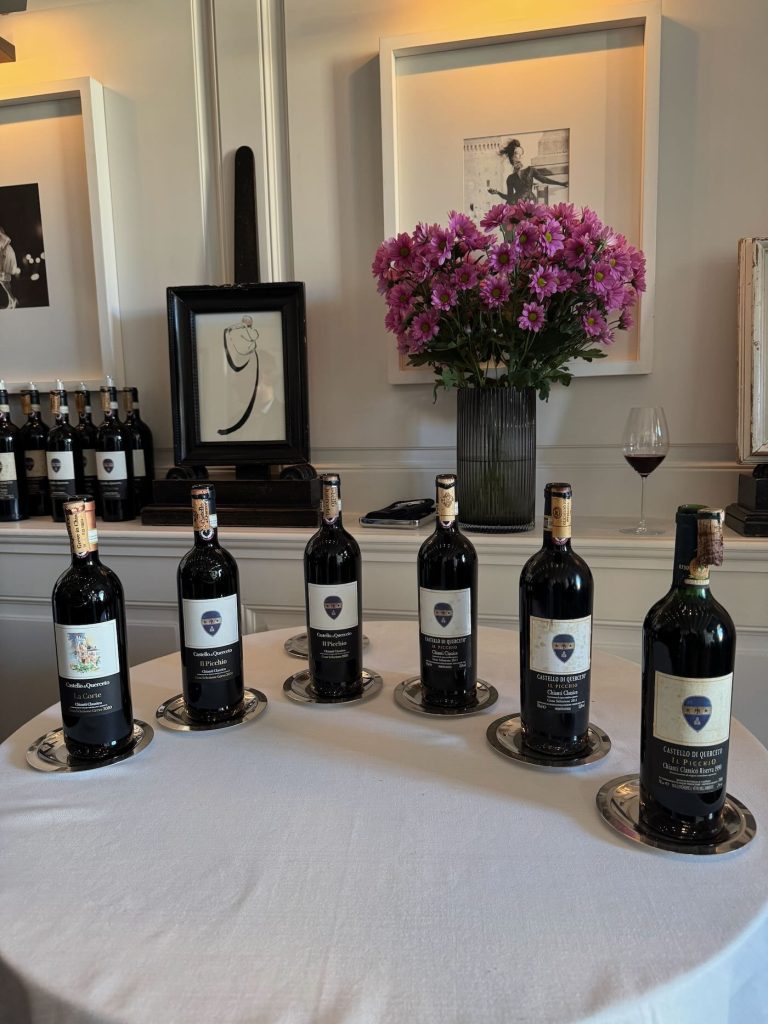
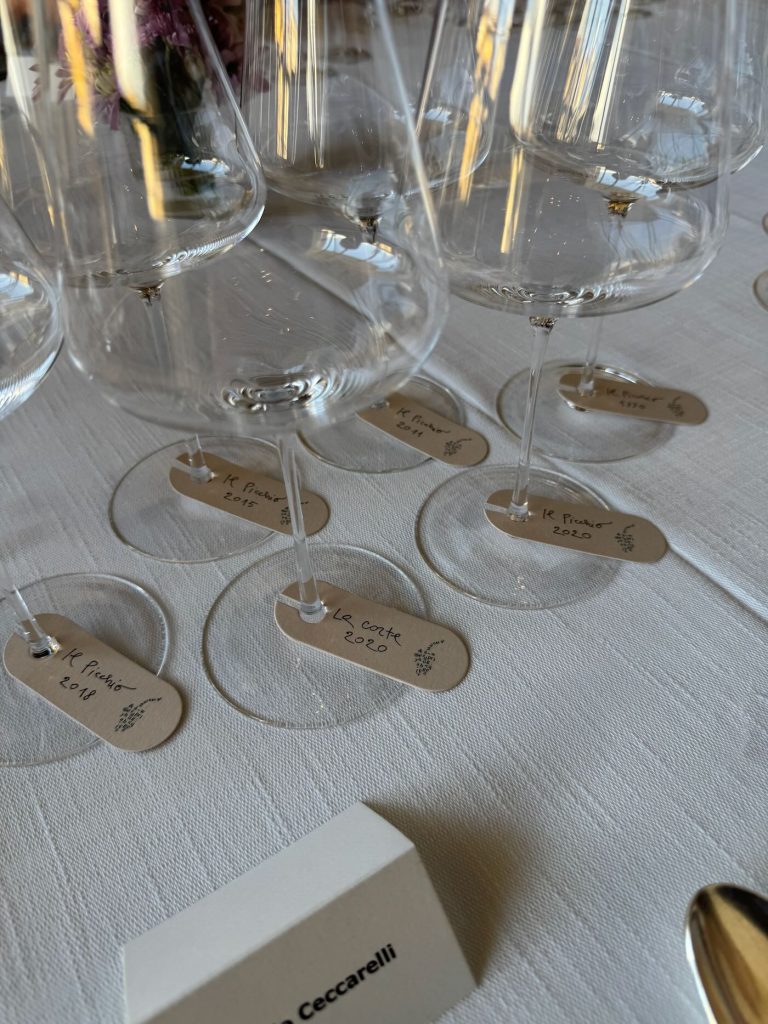
Il Picchio 2020
Deep crimson with garnet reflections already hinting at future development. The nose opens on fresh cherry and blackberry, moving toward violet and a confident spice profile of vanilla and clove. Rich on the palate, with dense, powerful tannins that give the wine real weight and volume — still young, but already well defined.
Il Picchio 2018
Similarly deep crimson in color. The aromas shift toward blueberry juice and ripe plum, still with violet, but here joined by white pepper, cinnamon and star anise. Acidity drives the palate, supporting fine, well-integrated tannins that stay closely linked to the fruit. A warm, generous mid-palate is balanced by a saline, acid-driven finish that keeps the wine lively.
Il Picchio 2015
A dense ruby red. Fruit takes center stage here, with blackberry jam upfront, backed by pepper, clove and tobacco. The palate shows ripe, generous tannins balanced by good freshness — a genuinely appealing equilibrium, intense and long on the finish.
Il Picchio 2011
Garnet and nearly opaque in the glass, showing clear signs of bottle age. The nose has moved into plum preserve, dried flowers and forest floor. On the palate it’s fully mature: flavorful, with tannins that carry the wine’s power through to a savory finish. Despite a warm vintage and years in bottle, it holds onto real balance and vitality.
Il Picchio 1990
The finale — and the highlight of the tasting. Dense garnet, with some sediment from age but still remarkably bright. This is where the wine gets genuinely exciting: candied orange peel, chestnut flour, cigar box and fig preserve, all expressed with a clarity that’s rare in a 30-plus-year-old wine. The palate is delicate and silky, carried by a fresh, saline thread that runs through a very long finish.
Why this matters if you’re planning a Chianti wine tour
Tasting Il Picchio across three decades isn’t just an exercise for wine geeks — it’s a compact lesson in what makes Chianti Classico worth traveling for. Sangiovese, softened with a touch of Colorino, shows power in its youth, complexity in maturity, and genuine charm once it’s had decades to settle. Few appellations in Italy offer that kind of range from a single label.
If you’re building a wine-tasting itinerary through Greve in Chianti, Castello di Querceto is worth the drive through the woods — both for the wines and for a sense of just how much history sits behind every bottle of Chianti Classico Gran Selezione.